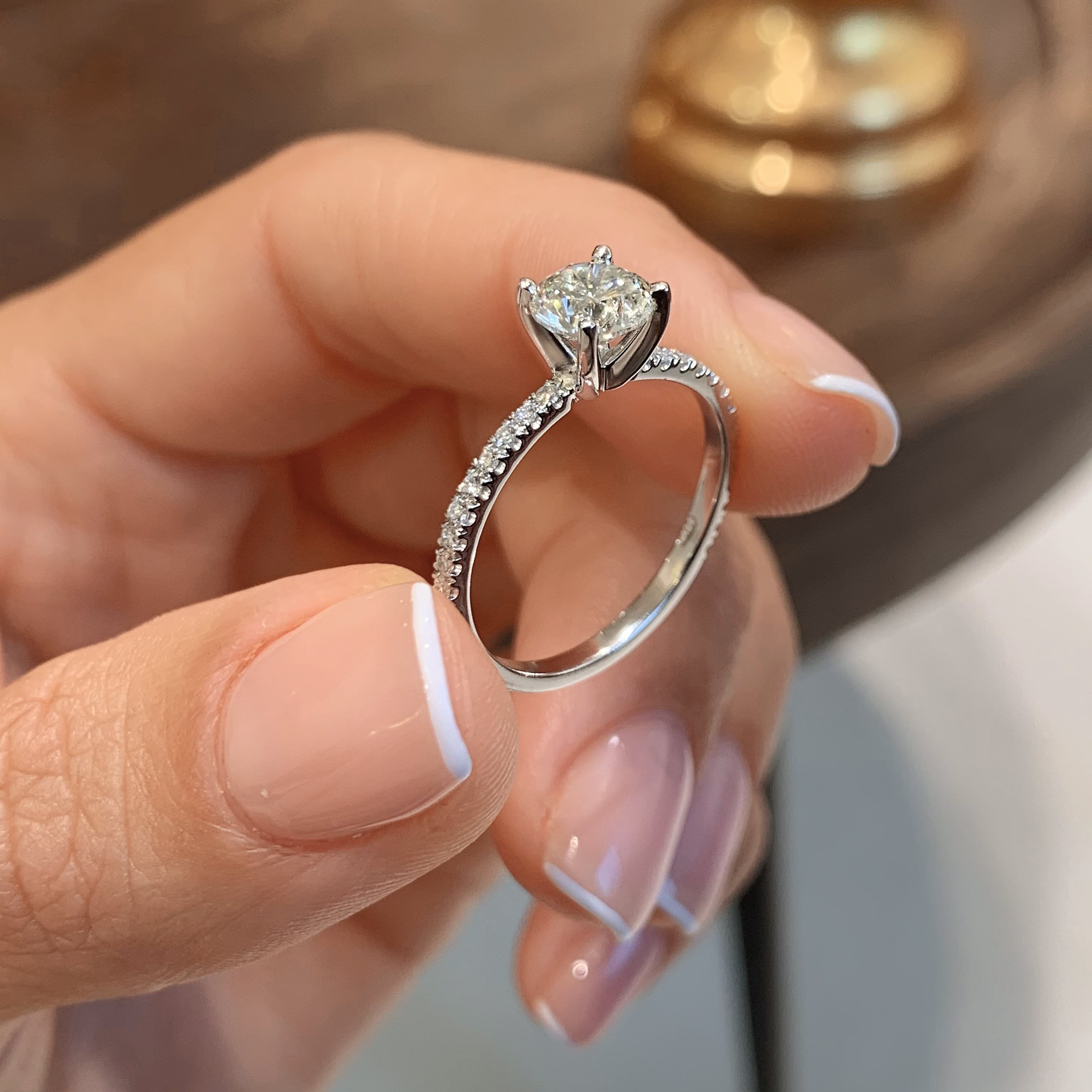


You know, after twenty years behind a jeweller’s bench, I’ve realised that people fall in love with diamonds for two main reasons: the sparkle… and the story. Every diamond, whether it’s fresh from deep within the earth or carefully created in a lab, has a tiny universe inside it — a history of light, pressure, and perfection. But here’s the funny thing: most of us never really see what’s happening beneath that surface. That’s where the diamond clarity chart comes in — and trust me, it’s one of the most misunderstood parts of diamond shopping.
When people walk into my Sydney workshop, they often know about the “4 Cs” — cut, colour, clarity, and carat. But when it comes to clarity, their eyes glaze over a little. “It looks clean to me,” they’ll say, peering at a stone through the loupe. And they’re not wrong. But clarity isn’t just about what your naked eye sees; it’s about what makes each diamond unique — those tiny, natural fingerprints called inclusions.
Let’s break it down like I would for a first-time customer (and I promise, no jargon overload).
Table of Contents
What Exactly Is “Clarity,” Anyway?
Clarity refers to the number, size, type, and visibility of internal and external characteristics in a diamond. Think of them as birthmarks. Every natural diamond forms under extreme heat and pressure, so it’s perfectly normal for them to have little imperfections inside (inclusions) or on the surface (blemishes). These can be microscopic crystals, tiny fractures, or faint clouds.
Now, not all inclusions are bad news. Some are so small they don’t affect the diamond’s sparkle or beauty at all. But larger or poorly placed ones can interfere with how light travels through the stone — dulling that brilliant, fiery reflection we all love.
That’s where the diamond clarity chart comes in handy. It’s a grading scale developed by the Gemological Institute of America (GIA) to help jewellers and buyers understand how “clean” a diamond really is.
You can take a closer look at the official diamond clarity chart for a full breakdown, but let’s go through it in plain language.
A Quick Tour of the Clarity Grades
At the top of the chart, you’ll find:
- FL (Flawless): No inclusions or blemishes visible under 10x magnification. These diamonds are incredibly rare and often come with eye-watering price tags. I’ve only seen a handful in my entire career — and they truly are breathtaking.
- IF (Internally Flawless): These stones might have a tiny surface blemish but no internal marks. To the naked eye, they’re identical to Flawless. Most people would never spot the difference, and honestly, even I sometimes have to double-check.
- VVS1 & VVS2 (Very Very Slightly Included): Minute inclusions that are extremely difficult to spot, even under magnification. If you’re after a diamond that looks absolutely perfect but doesn’t carry the price of a Flawless one, this is your sweet spot.
- VS1 & VS2 (Very Slightly Included): Small inclusions that are still hard to detect with the naked eye. A VS diamond can look just as brilliant as a flawless one, especially once it’s set in a ring.
- SI1 & SI2 (Slightly Included): You might start to see tiny inclusions here without magnification, but usually only if you know where to look. Many people happily buy SI diamonds because they strike a nice balance between value and visual beauty.
- I1, I2, I3 (Included): Inclusions are visible to the naked eye and can affect the diamond’s transparency and sparkle. These are usually budget-friendly, but as a jeweller, I’d advise caution — not every inclusion is harmless.
So, in short, clarity grades are like a snapshot of the diamond’s inner landscape. But — and this is something not everyone realises — clarity alone doesn’t define beauty.
What Your Eyes See vs. What’s on Paper
Here’s the truth I often share with my clients: most clarity differences are invisible once the diamond is set. An SI1 diamond can look identical to a VVS1 in a ring, especially if the inclusions are cleverly hidden by a prong or bezel. It’s a reminder that jewellery isn’t meant to live under a microscope — it’s meant to shine in the real world.
Sometimes, a customer will be torn between two stones — one VS1 and one SI1 — both identical in size and cut. I’ll lay them side by side under natural light, and nine times out of ten, they’ll pick the SI1. Why? Because their eyes aren’t drawn to the inclusions. They’re drawn to the sparkle, the way light dances across the facets. It’s a humbling thing — even with all our grading systems, emotion still wins.
A Word on Lab Grown Diamonds
Now, this might surprise you — but lab grown diamonds are graded using the same clarity scale as natural ones. They’re chemically and optically identical to mined diamonds, just made differently. Instead of taking billions of years to form underground, lab diamonds grow in controlled conditions that mimic nature’s process.
And the best part? Because they’re created in such a stable environment, they often have fewer inclusions. You’ll see a lot of VVS and VS clarity grades among lab grown diamonds, often at a fraction of the price of natural stones. From a jeweller’s point of view, it’s honestly fascinating — we’re watching technology reshape one of the most traditional industries in the world.
I’ve had brides walk in thinking lab grown meant “fake,” and leave completely enchanted after seeing one sparkle next to a mined diamond. You really can’t tell the difference with the naked eye.
The Emotional Side of Clarity (That Charts Don’t Show)
There’s something beautifully ironic about clarity grading — we’re measuring imperfections, yet those tiny flaws make each diamond unique. I’ve seen clients choose a slightly included diamond because one little crystal inside it looked like a star or a heart. They saw meaning in it. It’s a reminder that perfection isn’t always the goal; connection is.
One couple I worked with recently picked a diamond with a small feather inclusion that shimmered under the light. “It’s like the stone has a story,” the bride said. She wasn’t wrong. Every inclusion tells a tale of immense natural pressure and time. Even lab diamonds, though born from machines, carry a story of innovation and modern craftsmanship.
How to Choose the Right Clarity for You
Here’s my honest advice: clarity is just one piece of the puzzle. The cut affects brilliance far more than clarity does. If your budget is tight, I’d say prioritise an excellent cut first, then aim for a clarity grade where inclusions aren’t visible to the naked eye — typically VS2 or SI1. That’s the sweet spot for most people.
Also, always look at the diamond in person if you can. Lighting conditions, setting design, and even your own eyes make a difference. Some people are more sensitive to tiny marks than others. Trust what you see — not just the paperwork.
And don’t be shy about asking your jeweller to point out inclusions under a loupe. Once you spot them, you’ll probably never see them again with your naked eye — but it’s good to know where they are.
A Few Insider Tips
Since you’ve read this far, let me share a few little jeweller secrets about clarity:
- Clarity-enhanced diamonds: Some lower-clarity stones are treated to fill cracks or make inclusions less visible. They can look stunning, but make sure you’re aware of any treatments — they can affect durability and long-term value.
- Inclusion placement matters: A diamond with one small inclusion near the edge is far more desirable than one with a mark in the centre, even if both have the same grade. The lab’s report can’t always tell you that nuance.
- Sparkle hides a multitude of sins: A well-cut diamond refracts so much light that small inclusions simply vanish in the brilliance. It’s like a singer hitting the perfect note — you stop noticing the background noise.
- Certification counts: Always look for diamonds certified by trusted labs like GIA or IGI. It ensures your clarity grade is accurate and unbiased.
Why Clarity Still Matters (Even If It’s Not Everything)
While clarity might not be the most important “C,” it does play a subtle role in how a diamond ages. Stones with very large inclusions can be more vulnerable to chips or cracks if hit in the wrong spot. So, a good clarity grade isn’t just about beauty — it’s about durability too.
And let’s be honest: there’s a certain satisfaction in knowing your diamond has that extra touch of purity, even if you’re the only one who knows. It’s a private kind of luxury.
Final Thoughts — Beauty Beyond Perfection
When I hand over a finished engagement ring, the sparkle isn’t the only thing that lights up the room — it’s the emotion, the story, the connection. The clarity chart helps guide us, but it doesn’t define the meaning behind the diamond. Whether it’s flawless or slightly included, natural or lab grown, what really matters is how it makes you feel when you see it.
So, if you’re shopping for a diamond, take your time. Learn a bit about clarity, sure, but also trust your instincts. Let your eyes — and your heart — decide what looks and feels right. Because at the end of the day, a diamond’s true clarity isn’t just about what you see. It’s about what it says about you.